Evocative Editing
Connecting the field anew through photographs, film and writing
日本語 / Neither report nor concept / Is connecting arbitrary? / Trying it / Works / Workshops, presentations and exhibitions / Publications
An old man stamps hard on the floor as he dances. At night in a church, people raise and lower their hands to a hymn. Over a fire, stones are knocked down and stacked again, and under them food that has yet to appear is cooking. Each is an up-and-down movement towards something not yet present: God, or food in the ground. In a stadium, stamping goes with cheering. In these images from Malaita, it goes with prayer and with cooking.
The images come from The Dynamics of Nature and People (2023, three minutes), which Riho Hasegawa edited from footage the anthropologist Daisaku Hashizume shot on Malaita, in the Solomon Islands. At the time Hasegawa was an undergraduate in cultural anthropology. She had never been to Malaita and had not read Hashizume’s ethnography. Yet her film matched his understanding of the island. Land in which the ancestors are buried, dark with trees, is a source of fertility and of danger at once. Through one up-and-down movement after another, the film showed that the way people face that land and its darkness runs through how they dance, how they pray in church at night and how they cook beneath stones. In one respect it went further than his writing. In scenes such as the one where several men push a truck out of the mud, it showed the joy and the tension of facing the land more clearly than his ethnography had.
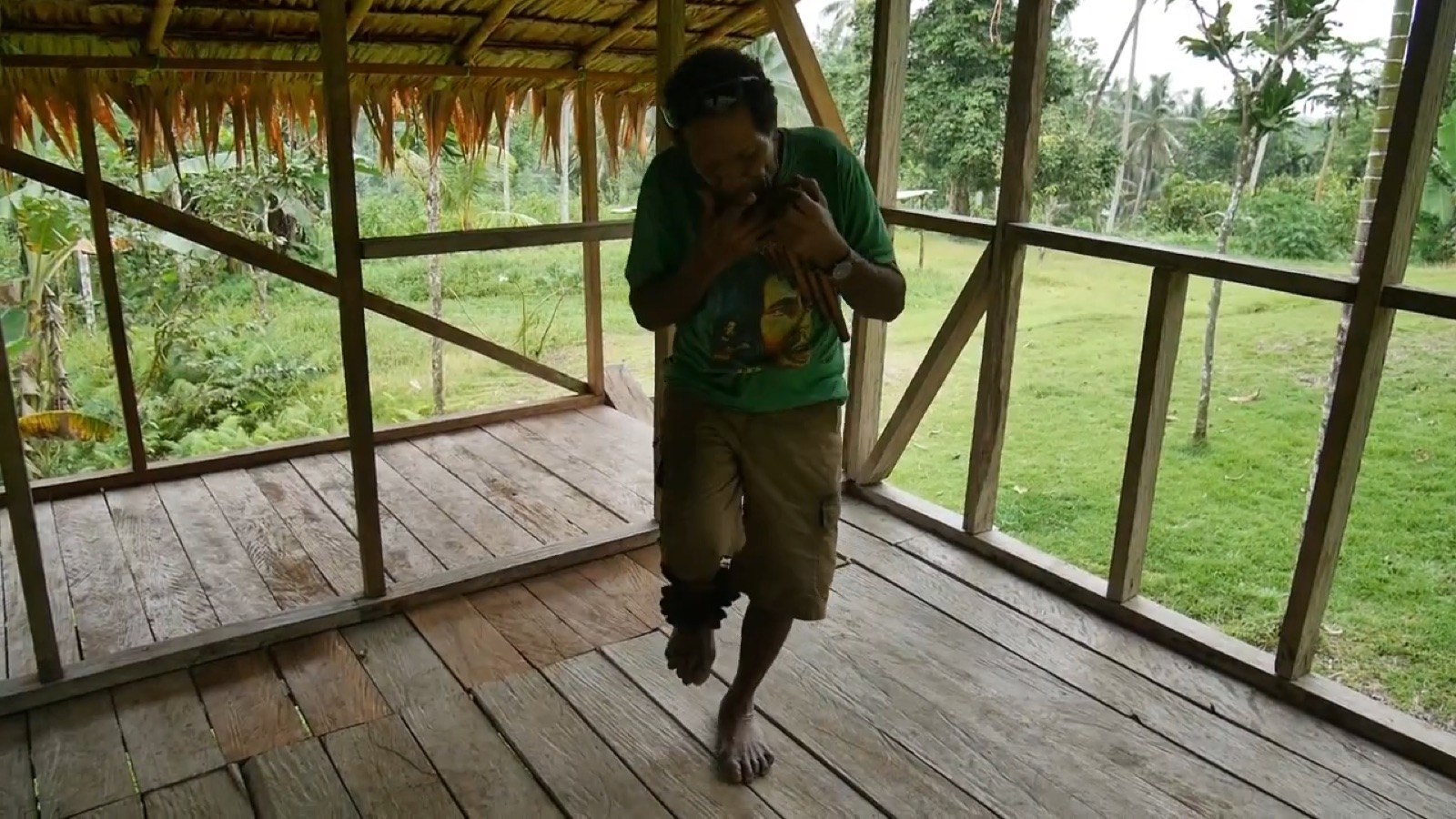
→ Watch The Dynamics of Nature and People on Vimeo
Evocative editing is a way of working with the photographs, footage and written cases that fieldwork leaves behind. You arrange them by feel first, and only once they are arranged do you ask what pattern their connections make. The aim is to reach ethnographic facts that neither a plain report nor a borrowed concept can reach.
Neither report nor concept
Fieldwork is less about collecting rare data than about arriving at thoughts that only the realities of one field make possible. That is harder than it sounds. Report that Christian Malaitans still fear their forest ancestors, and you will be asked: so what? Say that Malaitan dance has changed under globalisation, and you will be told: we knew that. Either way, our thinking barely moves.
What is particular to a field may lie less in single events than in the way events are connected. Stamping in a dance, hands rising and falling to a hymn, stones heated for an earth oven: only on Malaita are these tied together in just this way. Once that tie shows itself as a pattern, something that could not be said from one scene alone can be said. The old man’s stamping turns out to be not only a step in a dance but also one of many movements towards the land.
So in evocative editing we first make connections among images that fit the field, leaning as little as we can on existing categories. Only afterwards do we ask what pattern those connections make, and try to name it. The editor makes the connections. What they draw out are relations that were already latent in the field.
Is connecting arbitrary?
Can we really cut footage apart and sum it up? Can we connect things without letting the people involved speak? Almost everyone who tries evocative editing voices this fear first.
Anthropologists are usually taught to keep domains and positions apart. A meal is a meal and a ritual is a ritual; dancing means one thing to an old man and another to a young one. Writing that keeps things apart in this way is rarely doubted, because everything is, in fact, different. Writing that connects domains usually kept apart is hard to argue for and easily dismissed as impressionistic. Yet it is often arguments that connect which have changed anthropology. Malinowski took the kula, which looked like an economic institution, and tied it to the pursuit of rank, the widening of friendships, the decoration of canoes, spells and the growing of yams. That this now seems obvious is a sign that his argument succeeded.
Connecting still has weaknesses. The critics of Robert Gardner’s Forest of Bliss (1986), which we take as a forerunner of evocative editing, named them: film struggles to explain context, history and cause, and it can misread what things mean to the people involved. We treat these not as reasons to give up the method but as the predictable footprint of a heuristic. Knowing where it tends to go wrong, we can combine it with written ethnography, which handles context and local interpretation better. The fieldworker who shot the material can also check what the film shows against what they know.
Film also records what nobody intended. The old man at the start wears a Bob Marley T-shirt, and a viewer may wonder where he got it rather than watch his feet. But because film lets in what cannot be controlled, it unsettles the feeling that the field has already been written. The same man wears rattles around his ankle. Why rattles? Why does he stamp so often? Details that an account of the dance might pass over become questions within a pattern of movement towards the land. An understanding that only applies existing concepts runs aground here. Set beside film, written ethnography turns out to be one more way of evoking a world through a medium with properties of its own.
Trying it
Common steps
-
Choose images Look idly through the footage, photographs or written cases from fieldwork and pick out whatever catches your attention. If something seems obscure, or records a trivial event, pick it anyway if it feels right.
-
Arrange them roughly Arrange the images by intuition. Try to set aside both what you hope to say and the categories anthropologists usually reach for, such as religion here and performance there. Instead, go by the impressions the images give you: put similar things close together and different things far apart.
-
Ask why you arranged them so, and rearrange Once the images are laid out, look at the groups they form and at how the groups connect, and give names to the groups and their relations. When you have worked out what you were thinking as you arranged them, rearrange them so that it comes across more clearly.
-
Take in how others see them Show the images and explain what you meant. You will find out how they look to other people and what would make your point clearer. Move images around and rethink your explanation accordingly.
Film
In “Let’s Learn Fieldwork through Video Editing”, newcomers to anthropology edit footage shot by anthropologists. In the “Video Editing Workshop for Expanding Anthropological Thinking”, anthropologists who have done long-term fieldwork edit footage they shot themselves. Both use the kind of free editing software that comes with most computers. Participants only cut clips and change their order.
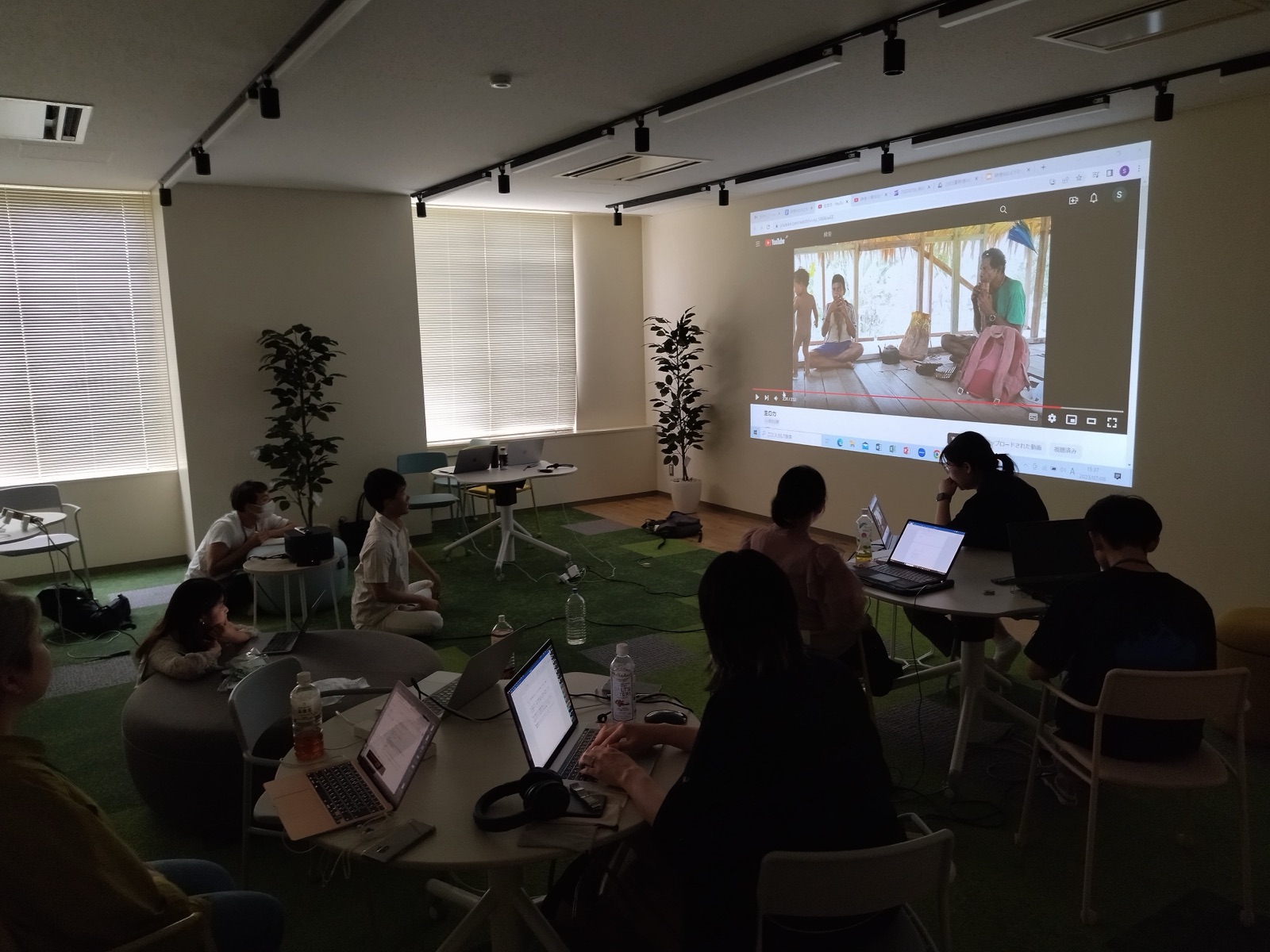
Review session of “Let’s Learn Fieldwork through Video Editing: Melanesia” (July 2023, Tokyo University of Foreign Studies)
Photographs
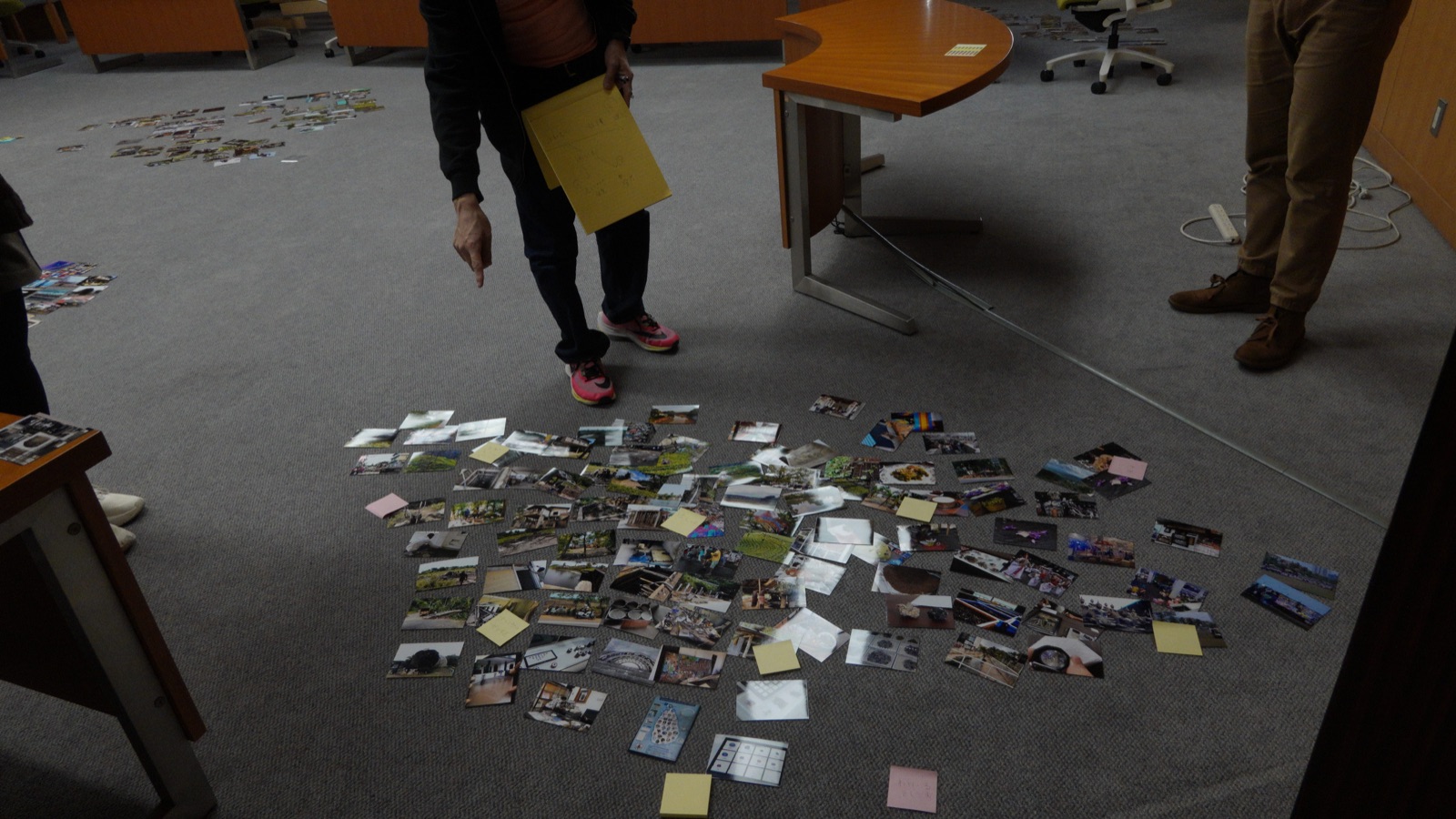
The short version is a workshop of about an hour, designed to convey anthropological thinking to people who are not specialists. Pairs draw photographs at random, make pairs of images and name them, then join up in fours to combine the pairs into larger groups and name the whole.
In the full version, several anthropologists each compose a set of photographs from the hundreds one anthropologist took during fieldwork, and the compositions are exhibited. The photographer then writes an essay in response to each composition.
Writing
Cases are cut out of an existing ethnography and recombined, to think something other than what that ethnography thought. We practise this in university undergraduate and graduate courses.
Works
Titles in brackets are translations. Statements, readings and responses are translated from the Japanese.
Films
Solomon Islands (footage: Daisaku Hashizume)
Riho Hasegawa 2023 The Dynamics of Nature and People [Shizen to hito no rikigaku]
Lapping, swaying, bursting, writhing. Taking the force of nature, and failing to take it. Resisting, and failing to resist. People play, sing, pull, fall.
Hikaru Sashida 2024 Moving Towards [Mukaiyuku mono]
I feel I must keep moving so as not to fall behind the flow of time. But really I want always to sway between moving and stopping. So I extended my body, so that it would be all right to stay, all right to let myself go. Sometimes we mark time, turn back, and set out again.
Shu Fujita 2022 Dancing Together [Minna de odoru]
Dancing together. The way this “together” is made is not the way other “togethers” are made. It is a “together” made without anything changing in kind from dancing alone. Perhaps, even alone, one is part of a “together” born in answer to the same nature as everyone else. Dancing together, in that sense.
Raglai, Vietnam (footage: Yanggu Kang)
Yanggu Kang 2024 Moving with Sound [Oto to tomo ni mukau]
The bodies and sounds you and I make are busily heading somewhere. Not hurrying. Only thickening and spreading. And where we arrive is a small gap. After a short rest, we start to stir again, heading somewhere else.
Shu Fujita 2024 Sowing Seeds, Giving Water [Tane o maku, mizu o ageru]
We are alive because someone sows the seeds and gives them water. Prayer goes with it.
Peru (footage: Shu Fujita)
Aguri Ide 2024 Things That Sway [Nabiku mono tachi]
Pushing back against the vibration of the air around us. When we ride on it and head the way we are pointed, we become us.
Shu Fujita 2023 What Does Not Pass By 2023 [Toorisuginai mono 2023]. Subtitles from Hiroshi Homura, Syndicate (1990)
What makes the oppressive overlap of bustle is each single bustle, and each one is a single gleam.
https://www.youtube.com/watch?v=S18X0sp36CY
Hiroto Tsuda 2021 Second Life in Peru
Edited from footage shot during anthropological fieldwork on Peruvian cuisine (February 2020).
Photo compositions
Doing Fieldwork through an Exhibition: Sri Lanka
Five anthropologists composed photographs by Ryo Tsuchida, an anthropologist who did fieldwork on floods and gemstones in Sri Lanka. Exhibited at Tokyo University of Foreign Studies (February 2025) and Kyoto City University of Arts (December 2025).
Shu Fujita, What Is Born of Mud
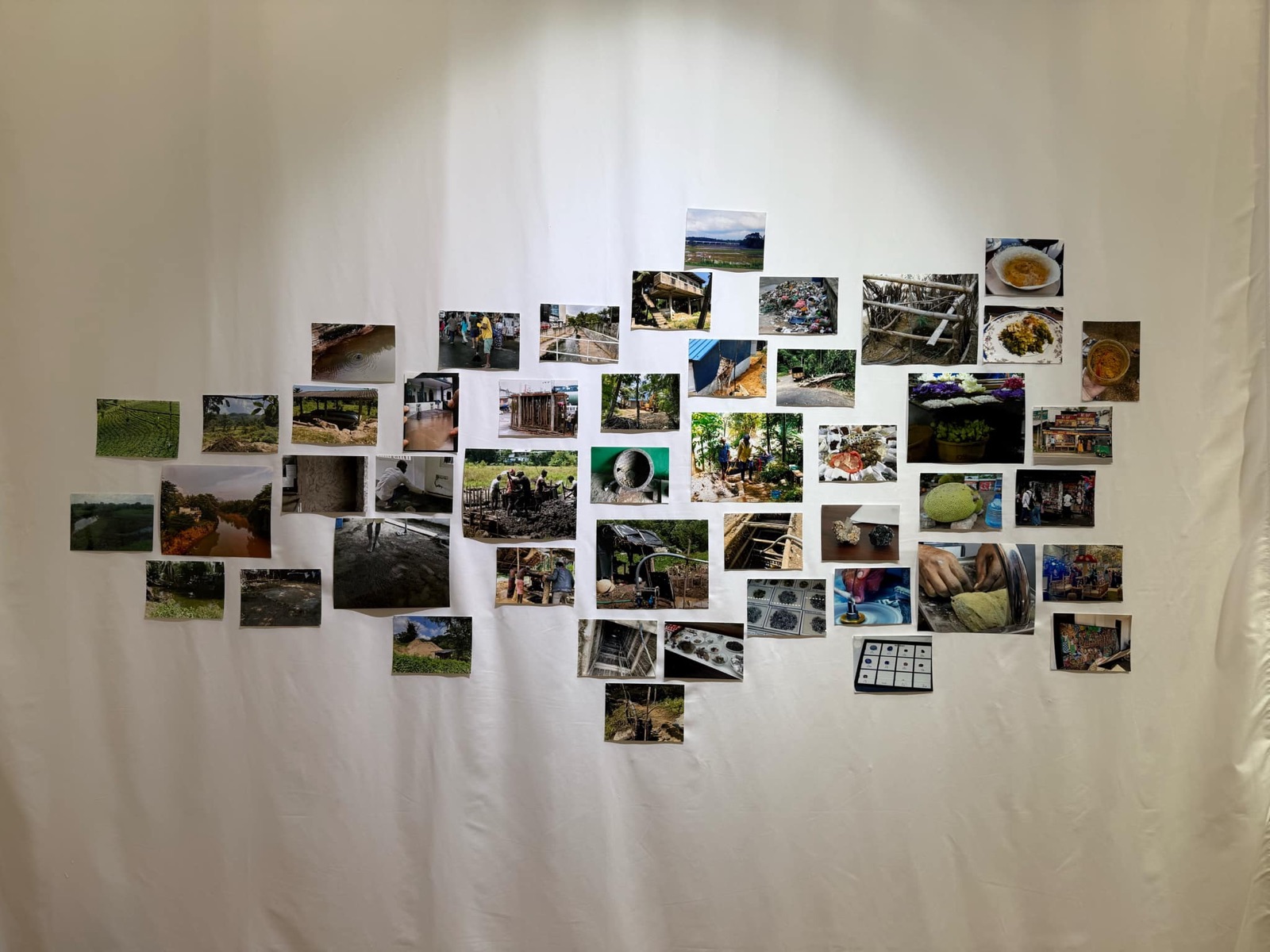
Mud sometimes overflows and causes trouble, but if food and shining stones are what is sorted out of mud, then either way people live mud.
Hiroto Tsuda’s reading: There is a horizontal flow. From the left comes what is called mud. Towards the centre, mud becomes a word given to embankments, to wall plaster, to flooded streets. In the middle, where the groups tangle, three photographs of a house frame, a sieve and a basket suggest shapes drawn out of the tangle. To the right, mud gives birth to food, and then to gemstones. On the photographs they are unmistakably alike. A city like a gemstone, a city like mud.
Ryo Tsuchida’s response: I know the smell of the mud, which way it flows and what it is. Mud did not stay inside the city; it filled it and went round it. You must not avoid mud; then you will notice the joy in what is born of it. Knowing mud was even knowing ourselves, or so it seems to me.
Daisaku Hashizume, Between Gods and Force
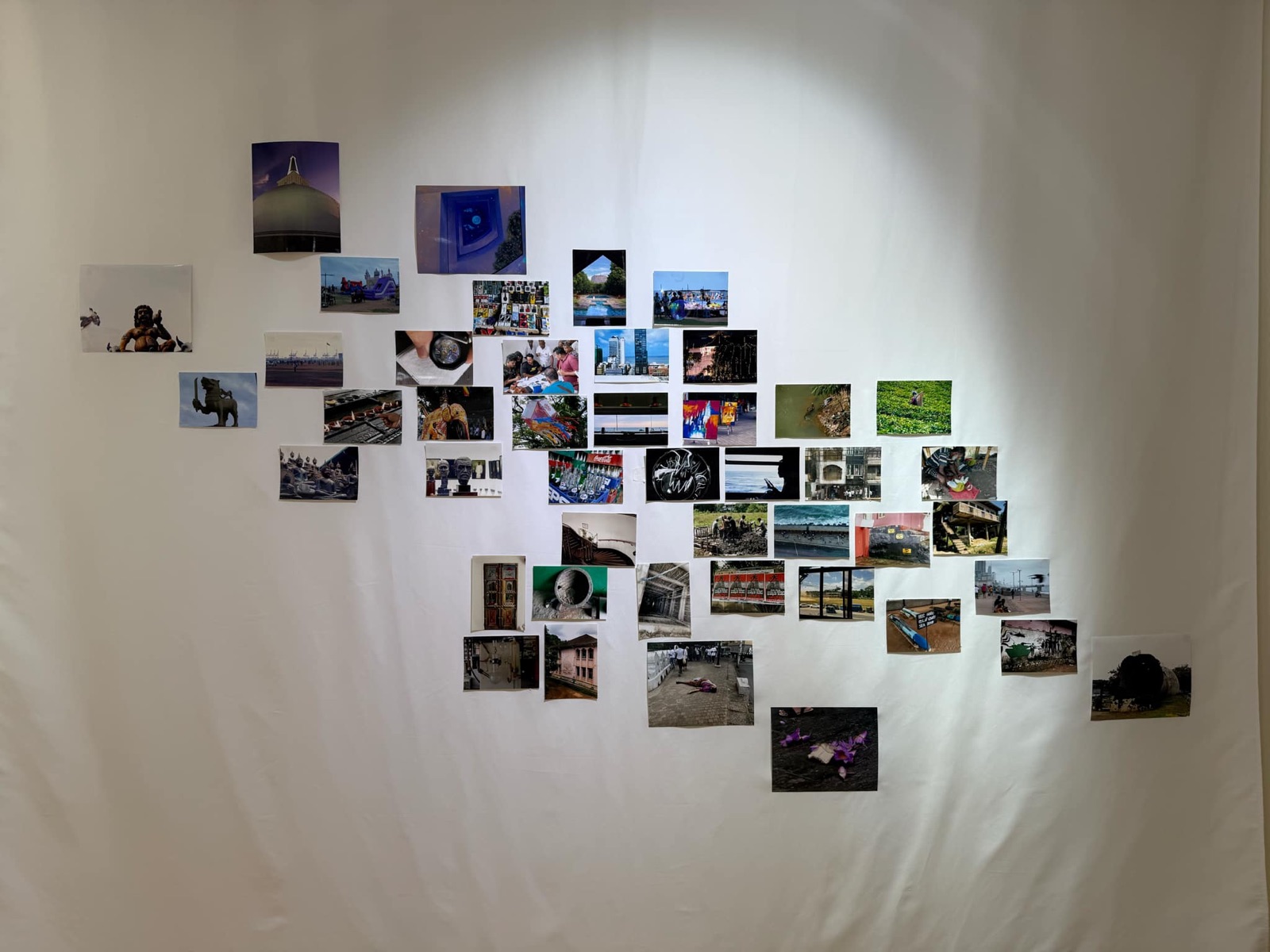
Prayer and prosperity thrusting into the void, an artificial paradise in blue-violet. The colourful, lively glitter fades in time. Lost wealth, the smell of violence and injustice. And every day the sea breaks on the shore, foretelling the return of what once passed through this land.
Shu Fujita’s reading: Curved things seem shaped by the past, or to give the past its shape. They are tied to the forms of gods and people. Yet giving up those forms does not bring only a straight, futuristic gleam. The straight lines that headed for the future are folded into the past too, and lose their liveliness. The force of violence, of sea and of earth runs through all of it, and there is a form in which that force takes over everything. There, blue-violet spreads.
Ryo Tsuchida’s response: A blue-violet both edgy and pale. Once seen it is not easily forgotten, yet its history is rarely noticed. I learn that great beings such as gods, and people’s ugliness, swirled and surged there. Is it simply calm now, or does it only look so? In that gap lies a return not yet seen.
Doing Fieldwork through an Exhibition: Philippines
Five editors, anthropologists and a documentary filmmaker among them, composed photographs from OUR CO-BLIND by Masato Ushimaru, who photographed a community that blind people built and run by themselves in Baguio, in the northern Philippines. Some laid the photographs flat; others built three-dimensional pieces and installations. Exhibited at Tokyo University of Foreign Studies (October 2025).
Riho Hasegawa, Strata of Traces
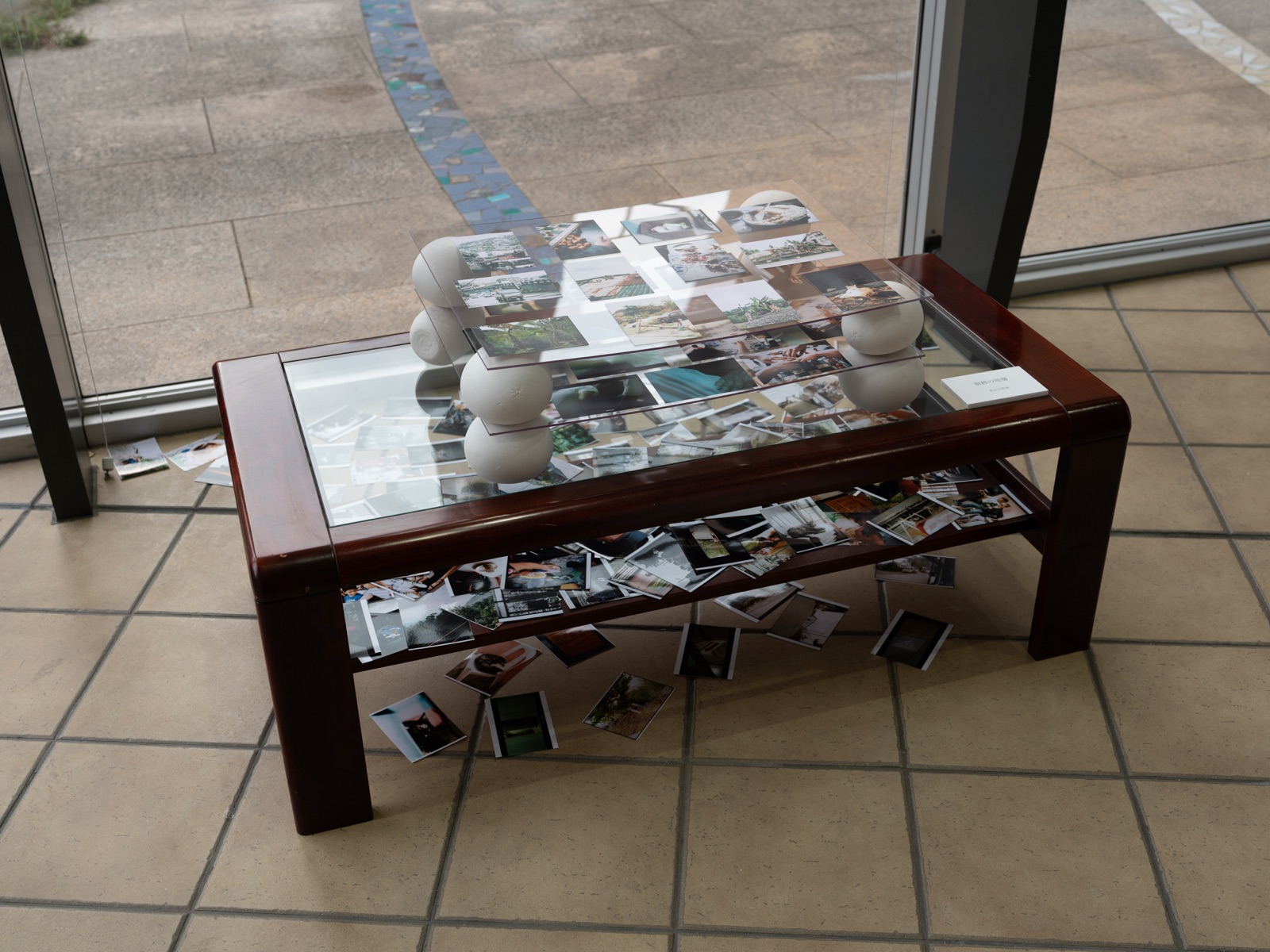
A sediment of things left behind, still wrapped in their presence; through each of its gaps, glimpses of how they were worked upon.
On the day of installation, Hasegawa set down bundles of photographs and saw that the piece could spread beyond the acrylic sheets, onto the glass table and onto the floor outside the glass wall. The title and statement came out of the arrangement that resulted.
Kunitaro Inoue, Pipes and Valves (The Seepage of a Thick Liquid)
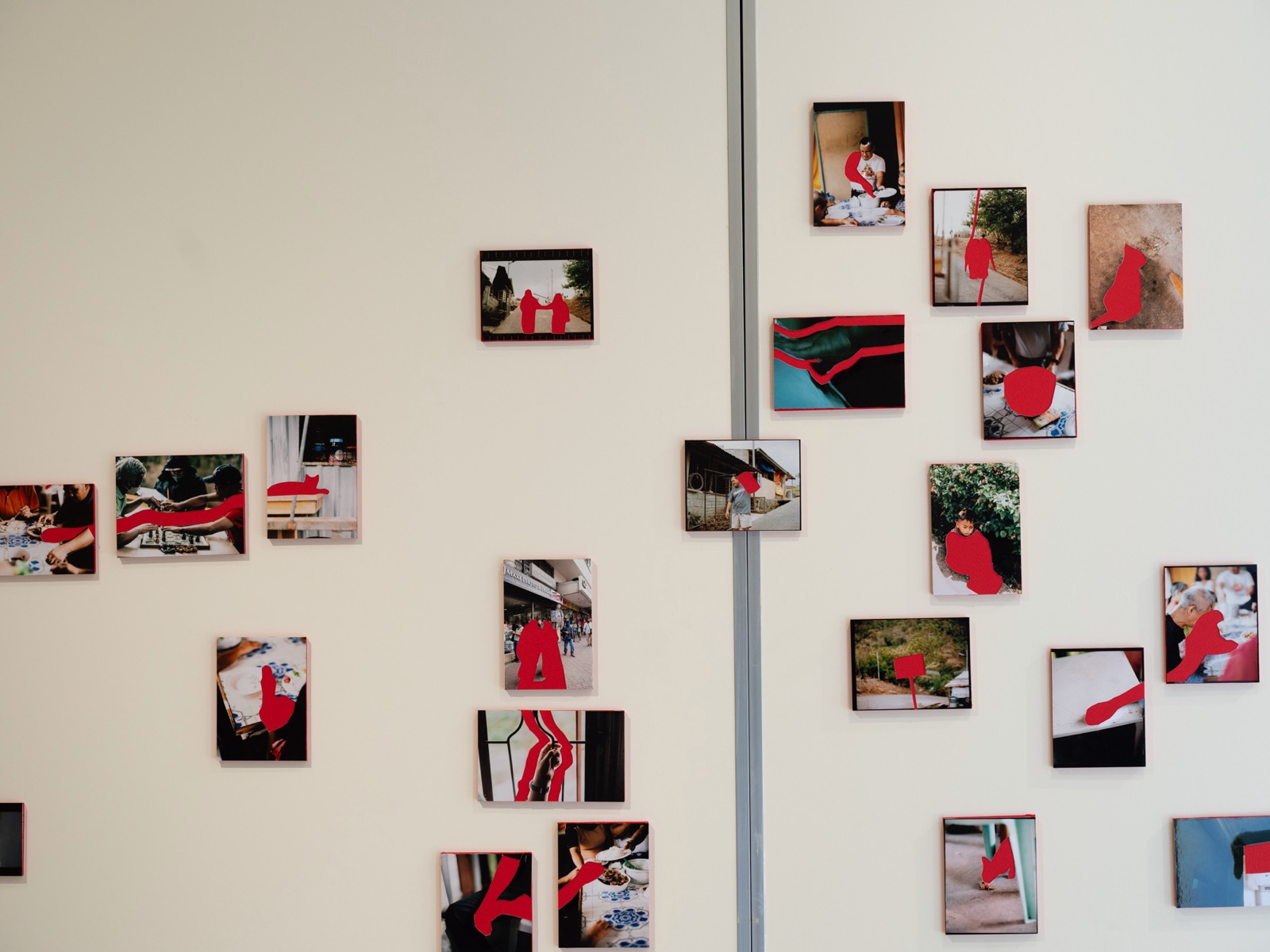
Inching along inside pipes that may not be there. Feeling I could go no further, or sitting down for a break, I put down roots, and familiar companions gathered round.
To trace how liquid flows and pools, I tried cutting the photographs. I cut out hands, vessels and cats and made a collage of them, but it did not work. What mattered was the ground left with holes in it. Pipes and valves were pulsing there.
Workshops, presentations and exhibitions
December 2024: “Video Editing Workshop for Expanding Anthropological Thinking 2025”, TUFiSCo workshop, Tokyo University of Foreign Studies (guest lecturer: Hiroto Tsuda)
April 2024: “Let’s Learn Fieldwork through Video Editing: Vietnam 2024”, TUFiSCo workshop, Tokyo University of Foreign Studies (guest lecturer: Yanggu Kang)
March 2024: “Let’s Learn Fieldwork through Video Editing at Mercari Anthropology Lab”, Mercari Tokyo office
February 2024: “Let’s Learn Fieldwork through Video Editing: Peru 2024”, TUFiSCo workshop, Tokyo University of Foreign Studies (guest lecturer: Irina Grigore)
November 2023: “Video Editing Workshop for Expanding Anthropological Thinking”, TUFiSCo workshop, Tokyo University of Foreign Studies (guest lecturer: Hiroto Tsuda)
July 2023: “Let’s Learn Fieldwork through Video Editing: Melanesia”, TUFiSCo workshop, Tokyo University of Foreign Studies (guest lecturer: Daisaku Hashizume)
June 2023: “Towards Open Ethnographic Filmmaking: The Method and Significance of a Workshop on Visual Thinking” (with Hiroto Tsuda and Daisaku Hashizume; screening and paper), 57th Annual Meeting of the Japanese Society of Cultural Anthropology, Prefectural University of Hiroshima
February 2023: “Let’s Learn Fieldwork through Video Editing”, TUFiSCo workshop, Tokyo University of Foreign Studies
June 2022: “Second Life in Peru / What Does Not Pass By” (with Hiroto Tsuda; screening), 56th Annual Meeting of the Japanese Society of Cultural Anthropology, Meiji University
Publications
Fujita, Shu, Hiroto Tsuda, Daisaku Hashizume and Yanggu Kang. In press. “Ethnographic Film as a Heuristic for Written Ethnography: Positioning Film Editing through ‘Evocative Film’” [in Japanese]. Japanese Journal of Cultural Anthropology 91(3), December 2026. Describes Robert Gardner’s Forest of Bliss alongside three evocative films, The Dynamics of Nature and People, Facing the Land and Moving with Sound, and argues that ethnographic film can reveal ethnographic facts that could be written but have not yet been. It also identifies the systematic limits of evocative film as a heuristic.
Fujita, Shu and Hiroto Tsuda. 2025. “Methods of ‘Let’s Learn Fieldwork through Video Editing’: For the Pursuit of the Intra-Image Understandings of Fields” [in Japanese]. Journal of Asian and African Studies, Supplement 6: 115–143. Introduces a video-editing workshop for learning, in a short time, a process of anthropological thinking usually thought to need long experience: how lectures, editing and review sessions are run, and how comments in review sessions shift the understanding of a film.
About this page
Evocative editing is developed by Shu Fujita and Hiroto Tsuda, with Daisaku Hashizume, Yanggu Kang, Riho Hasegawa and others.